

Total Knee Replacement Surgeon in SC
A total knee replacement is a surgery to replace diseased or damaged knee joint with an artificial knee joint made of materials, such as metal or plastics. Dr Pinski provides diagnosis and individualized non-operative and operative treatment plans in SC. Dr Pinski also provides highly specialized care during and after surgery. Contact Dr Pinski’s office for an appointment today!
What is Total Knee Replacement?
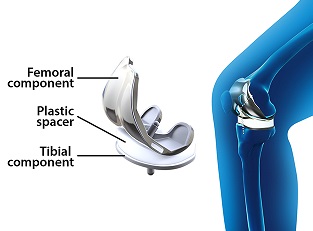
Total knee replacement, also called total knee arthroplasty, is a surgical procedure in which the worn out or damaged surfaces of the knee joint are removed and replaced with an artificial prosthesis.
What is Knee Arthritis?
The knee is made up of the femur (thighbone), tibia (shinbone) and patella (kneecap). The two menisci, the soft cartilage between the femur and tibia, serve as a cushion and help absorb shock during motion. Arthritis (inflammation of the joints), injury or other diseases of the joint can damage this protective layer, causing extreme pain and difficulty in performing daily activities in an arthritic knee, the cartilage itself becomes thinner or completely absent. In addition, the bones become thicker around the edges of the joint and may form bony “spurs”. These factors can cause pain and restrict the range of motion in the joint.
What are the Indications for Total Knee Replacement?
Total knee replacement surgery is commonly indicated for severe osteoarthritis of the knee. Osteoarthritis is a type of arthritis. It is the most common form of knee arthritis in which the joint cartilage gradually wears away, and often affects the elderly. Your doctor may advise total knee replacement if you have:
- Severe knee pain that limits your daily activities (such as walking, getting up from a chair or climbing stairs)
- Moderate-to-severe pain that occurs during rest or awakens you at night
- Chronic knee inflammation and swelling that is not relieved with rest or medications
- Failure to obtain pain relief from medications, injections, physical therapy or other conservative treatments
- Instability
How is the Total Knee Replacement Procedure Performed?
The goal of total knee replacement surgery is to relieve pain and restore the alignment and function of your knee.
- The surgery is performed under spinal or general anesthesia with a lower extremity block.
- An incision is made the skin over the affected knee to expose the knee joint. Then, the damaged portions of the femur and tibia are cut at appropriate angles using specialized jigs to create a creates a smooth surface for the implants.
- Trial implants are placed to assess size and ligamentous stability of the knee after the bone ends are prepared.
- Once a balanced knee is achieved, the real femoral and tibial components are then implanted. They can be attached to the bones using bone cement or through cementless implant technology. Bone cement acts as a grout by interdigitating with the cancellous bone and the implant interface creating a stable bond. Cementless implants utilize a special coating on the undersurface of the implants that allow for bony ingrowth to create long term stability.
- Once the femoral and tibial components are inserted, the real plastic liner (highly cross linked polyethylene) is inserted. The liner provides a smooth gliding surface for movement.
- The patella(kneecap) can be resurfaced if there is significant arthritis or there is poor tracking. The undersurface of the patella cut and a plastic button is placed. Not all patellas are resurfaced.
- The femoral component, the tibial component, the liner and the patellar button are the new knee joint
- With the final components in place, the knee undergoes a final stability test throughout the entire range of motion.
- The joint is then washed with a sterile solution. The knee joint is closed in a layered fashion and a sterile waterproof dressing is placed over the incision.
What Does Postoperative Care for Total Knee Replacement Involve?
Recovery begins immediately following the surgery. On the day of surgery, you will walk using a walker and climb stairs. A physical therapist will teach you specific exercises to strengthen your leg and restore knee movement, including a home exercise program. Home therapy can be utilized for the first two weeks post operatively, with the goal of transitioning to outpatient physical therapy as soon as possible.
What are the Risks and Complications of Total Knee Replacement?
As with any major surgery, the possible risks and complications associated with total knee replacement surgery include:
- Knee stiffness
- Infection
- Blood clots (deep vein thrombosis)
- Nerve and blood vessel damage
- Ligament injuries
- Patella (kneecap) dislocation
- Plastic liner wearing out
- Loosening of the implant
For more information about our services or to schedule an appointment, call us at or click here to request an appointment online. We’ll respond to you as soon as possible.


